
Short answer: A refractometer for homebrew wort is most helpful when it produces comparable readings at repeatable stages of the brew. The PAL-1 listing gives a 0.0-53.0% Brix range, ±0.2% Brix accuracy, 0.1% Brix resolution, LCD display and two AAA batteries. Use it as a Brix instrument: prepare a representative sample, keep foam and sediment out of the measuring area, zero-set with water and note the sample stage. Before fermentation, Brix can support a conversion to SG. After fermentation begins, retain original-gravity data and apply an explicit correction method.
Choose the sampling moment
Homebrew wort changes during mash, sparge, boil and cooling, so a Brix value only answers the question attached to its sampling moment. A pre-boil sample can support one decision, while a post-boil or fermenter sample answers another. Label the stage in the brew log and do not compare two numbers as though they came from the same liquid.
The PAL-1's listed range is 0.0-53.0% Brix, with 0.1% Brix resolution and ±0.2% Brix accuracy. Those are useful boundaries for choosing the instrument, but they do not tell you whether a sample with foam, trub or high viscosity is representative. The seller does not publish a wort-specific sampling protocol.
| Sample label | Write beside the Brix value | Avoid |
|---|---|---|
| Pre-boil | Kettle stage, volume and time | Comparing directly with fermenter readings |
| Post-boil | Cooling stage and any dilution | Sampling only a surface layer |
| Fermenting | Original gravity, current Brix and date | Calling raw Brix final SG |
Prepare a clean sample
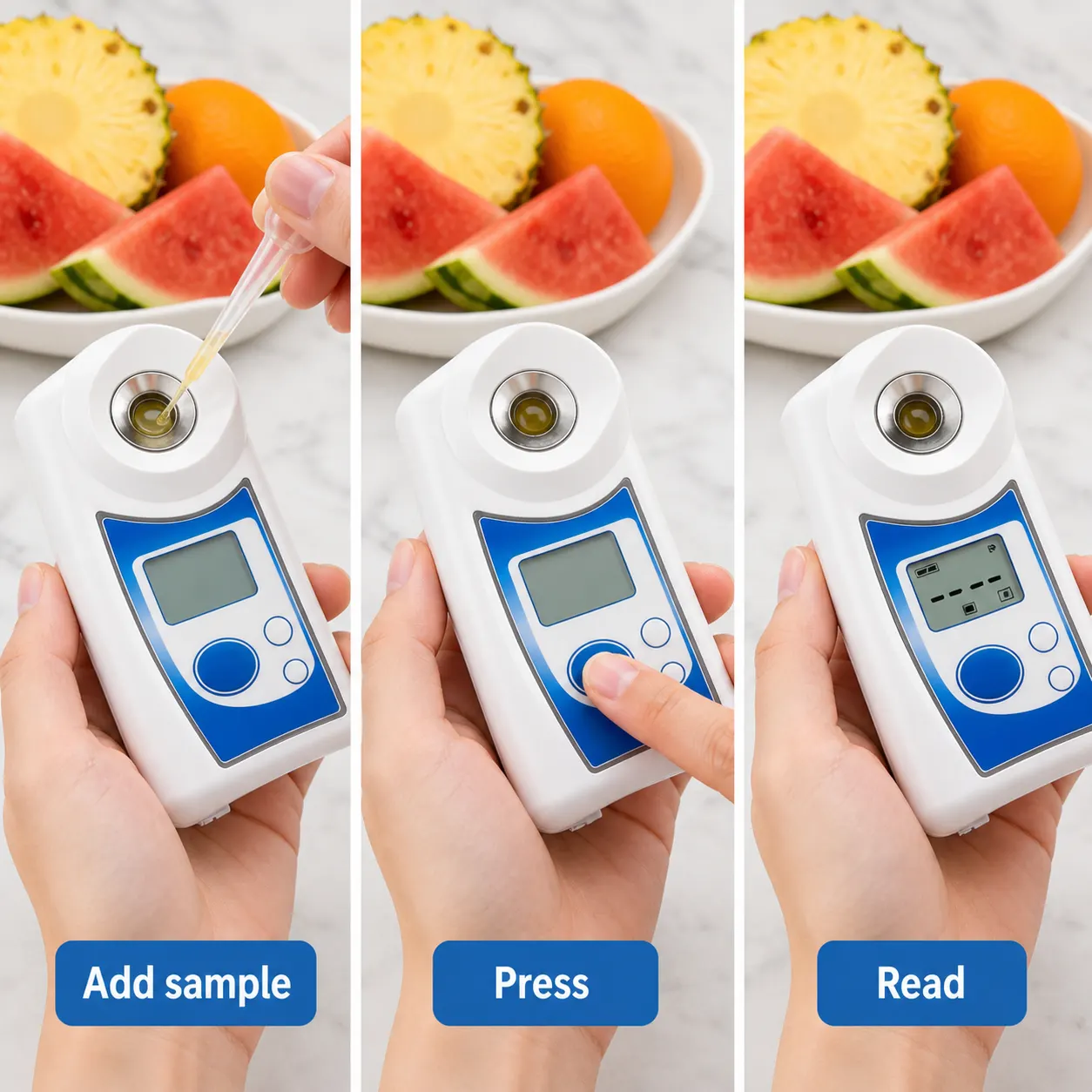
The optical surface should be clean and covered by a representative portion of wort. Remove foam, avoid transferring large solids and let the sample approach the temperature recommended by the PAL-1 manual. If the wort is hot, take it away from the heat source before measuring. The seller page does not specify an exact sample volume, so keep the instrument's measuring area covered without claiming an unlisted amount.
Zero-setting gives the session a known baseline. Use water as described in the manual, then rinse and dry the prism after each sample. If readings vary, first check the sample preparation, temperature, residue and stage label before blaming the display. A repeatable routine is more useful than a single impressive-looking number.
- Write the sample stage and batch name before collecting the portion.
- Zero-set with water, prepare a low-foam portion and allow it to move towards the recommended temperature.
- Measure, record Brix and note whether the sample includes visible sediment or has been diluted.
- Clean and dry the prism so the next reading begins with the same surface condition.
Convert with the right context
For unfermented wort, a Brix-to-SG conversion can be used when your recipe or brew record requires SG. For fermenting wort, a correction method needs the original gravity or original Brix because alcohol changes the optical relationship. Brewfather's documentation separates these two workflows and treats fermented refractometer readings as corrected calculations rather than direct SG observations.
The PAL-1 product page does not document an SG scale or built-in correction calculator. Keep the raw Brix, the original reading and the correction method in your notes. If another person reviews the batch, they should be able to see which value came from the instrument and which value came from later calculation.
Know what remains unknown
The published product facts do not specify a wort-specific validated method, sample volume, response time, repeatability in a particular recipe, calibration certificate or battery runtime. Manufacturer does not specify those points on the seller page. The absence is not evidence that the meter cannot be used; it is a reason to keep the claim narrow.
Before ordering, compare the listing with your actual bench: room for safe cooling, a cleaning routine, a way to record original gravity and a correction tool for fermentation. If you need a guaranteed result for a defined lab method, obtain the required documentation first. Do not infer it from the 0.1% display increment.
Related guides and product details
The PAL-1 is best treated as a documented Brix input for a careful brew log, with conversion and fermentation correction kept visible outside the instrument. Read Brix Refractometer UK: What to Check Before You Buy for related guidance. Read Brix to SG Correction: When a Refractometer Reading Needs Context for related guidance. Review the documented specification on the PAL-1 digital hand-held "pocket" refractometer, 0.0-53.0% brix product page before ordering.
Sources and safety context
- Supports the seller's range, accuracy, resolution, LCD and battery facts. PAL-1 digital hand-held pocket refractometer product page.
- Supports water zero-setting, sample temperature and prism care. ATAGO PAL-1 Refractometer Instruction Manual.
- Supports the distinction between unfermented conversion and fermented-reading correction. Brewfather refractometer documentation.