
Short answer: A digital Brix meter can help a jam maker compare batches with a small sample, but it should not be used as a shortcut around recipe method or heat safety. The PAL-1 listing gives a 0.0-53.0% Brix range, ±0.2% Brix accuracy, 0.1% Brix resolution, LCD display and two AAA batteries. The useful routine is to zero-set with water, let a sample move away from cooking heat, avoid foam and fibres, and record the same sampling point each time. The seller does not specify a jam-specific endpoint, sample volume or guaranteed result for every recipe.
What Brix can tell a jam maker
Brix is useful for recording soluble-solids readings across fruit, sugar and syrup work, especially when the same recipe is repeated. It gives you a number to compare between batches, but it does not replace the recipe's wider checks. A digital Brix meter cannot establish gel strength, pectin activity, acidity, microbial safety or storage life from the number alone.
The PAL-1 is listed with a 0.0-53.0% Brix range. That may cover the intended reading, but the product page does not publish a jam-specific target, conversion or endpoint. Write the target used by your tested recipe separately and do not turn a generic Brix reading into a universal set-point.
| Check | Why it matters | What the listing says |
|---|---|---|
| Brix scale | Shows the measurement language for the sample | 0.0-53.0% Brix is in the product name |
| Resolution | Sets the displayed increment | 0.1% Brix |
| Accuracy | States the published instrument claim | ±0.2% Brix |
| Jam endpoint | Connects the reading to a recipe decision | Manufacturer does not specify |
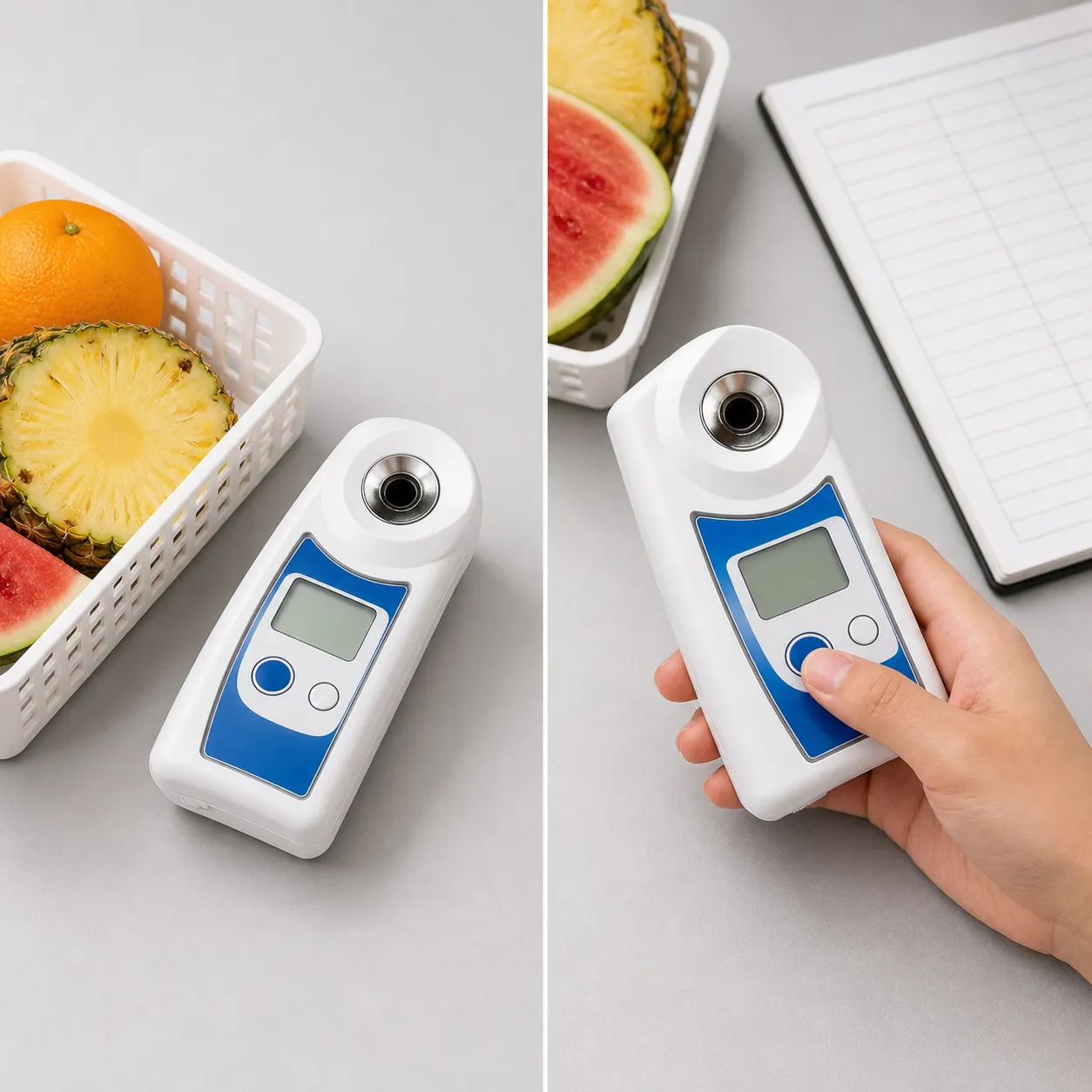
Cool and prepare the sample
Do not treat a hot pan as a sample cup. Remove a small portion safely, let it move towards the temperature recommended by the PAL-1 manual, and keep the sample free of bubbles, skins and large fruit pieces that could interfere with the measuring area. The product page does not specify sample volume or a maximum jam temperature, so those details must come from the manual and your process.
A thick, uneven mixture can make comparison difficult even when the display is easy to read. Record where the sample came from: early boil, after sugar dissolves, or before filling. For repeat batches, use the same moment and preparation method. That gives the Brix number a traceable place in the recipe instead of pretending it is an independent verdict.
- Zero-set the clean prism with water before the session and confirm the display returns to the expected zero point.
- Take a safe portion away from the pan, let it approach the recommended sample temperature and remove foam or large solids.
- Apply the sample, wait for the reading and record Brix with the recipe stage and batch identifier.
- Rinse and dry the prism before the next sample so sugar residue does not become the next reading's hidden variable.
Keep calibration and endpoint separate
Calibration or zero-setting checks the instrument's baseline; it does not calibrate the recipe or prove that a jam will set. ATAGO's PAL-1 manual describes water zero-setting and sample-temperature handling. Follow that procedure before comparing batches, particularly after battery changes or a change in the working environment if the manual calls for it.
The listed ±0.2% Brix accuracy and 0.1% Brix resolution should be read as instrument specifications, not as a guarantee that a hot, fibrous or unusually viscous jam will produce a decision-ready result. Keep the cooking method, acidity check and set test in the same record. A meter is one observation inside the process.
Boundaries before ordering
The PAL-1 is a plausible fit for a jam maker who wants a handheld digital Brix reading and can take a prepared sample. It is not documented as a complete jam-quality system. Manufacturer does not specify a jam endpoint, sample volume, viscosity limit, probe or pan-safe accessory, certification or performance in every fruit-and-pectin mixture.
Before buying, confirm the detail that would make the tool unsuitable: the reading range you need, how you will cool and sample the jam, whether the LCD is readable in your workspace and whether the included package is sufficient. The seller page lists two AAA batteries but does not turn that into a runtime promise. Keep those limits visible in the purchase decision.
Related guides and product details
The PAL-1 can support repeatable Brix records for jam work when samples are prepared safely and consistently, but the recipe endpoint still needs its own evidence. Read Refractometer for Home Brewing UK: A Careful Buying Guide for related guidance. Read Refractometer for Homebrew Wort: Sampling Without Guesswork for related guidance. Review the documented specification on the PAL-1 digital hand-held "pocket" refractometer, 0.0-53.0% brix product page before ordering.
Sources and safety context
- Supports the seller's Brix range, accuracy, resolution, display and battery facts. PAL-1 digital hand-held pocket refractometer product page.
- Supports water zero-setting, sample temperature and prism handling guidance. ATAGO PAL-1 Refractometer Instruction Manual.
- Supports the manufacturer model range, resolution and accuracy context. ATAGO PAL-1 manufacturer specification.