
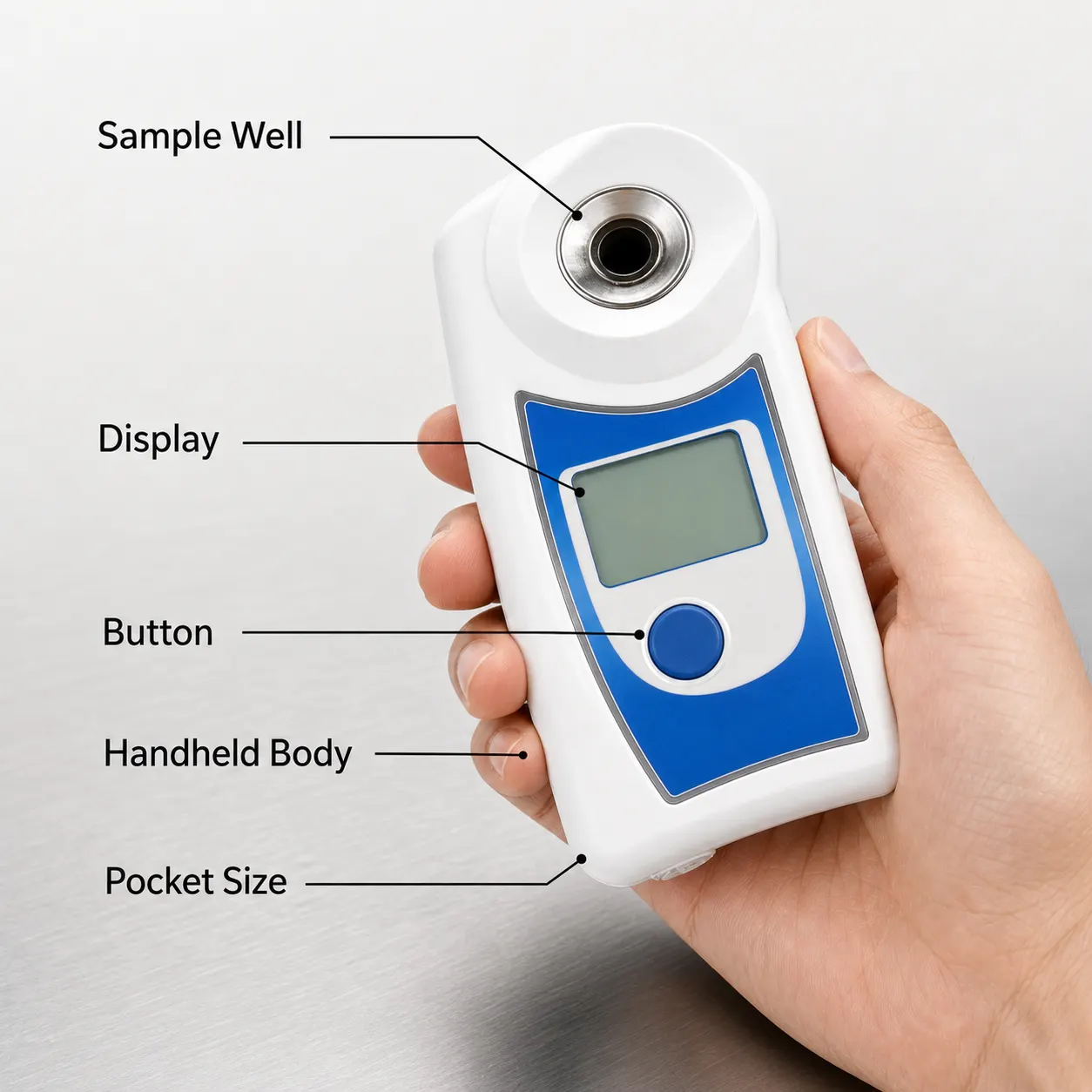
Short answer: A Brix refractometer can turn a small liquid sample into a useful concentration reading, but the number only helps when the sample and instrument are prepared consistently. The PAL-1 listing gives a 0.0-53.0% Brix range, ±0.2% Brix accuracy, 0.1% Brix resolution, an LCD display and two AAA batteries. Before buying, check whether those published facts match your liquid, recording method and working space. Plan how you will zero-set the prism, keep samples representative and record temperature. Do not infer field performance, probe-like accessories or extra measurement modes: where the product page is silent, manufacturer does not specify.
Match the range to the liquid
The listing presents the PAL-1 as a 0.0-53.0% Brix refractometer. That is the first fit check for fruit juice, wort, syrup or another liquid where a Brix result is the intended measurement. Brix is a concentration scale based on refractive behaviour, so it should not automatically be treated as salinity, alcohol percentage or a finished specific-gravity result. The product page does not specify a sample-specific conversion for every liquid.
The number you need may also be narrower than the instrument's headline range. Write down the sample type, expected reading and decision attached to it before ordering. If your process requires a validated method, traceable calibration certificate, sample viscosity limit or a particular conversion table, manufacturer does not specify those details on the storefront page. Treat them as confirmation questions rather than assumptions.
| Published point | What it supports | What remains open |
|---|---|---|
| 0.0-53.0% Brix | A stated Brix measurement range | Suitability for every non-sucrose liquid |
| ±0.2% Brix accuracy | The listed accuracy claim | Performance in your sample and process |
| 0.1% Brix resolution | The displayed increment | Whether that increment equals decision-grade accuracy |
| LCD and two AAA batteries | Display and power arrangement | Runtime, spare-battery life and environmental limits |
Prepare the prism and sample
Use a clean, dry prism and a sample that represents the liquid you want to compare. The PAL-1 instruction manual describes zero-setting with water and advises allowing the sample to reach the instrument's ambient temperature before measurement. For a brew or kitchen bench, take a small portion, mix it if the process allows, remove visible foam and avoid carrying sediment or fruit fibres onto the prism. The listing itself does not state a required sample volume.
Keep the same sampling habit between readings. A top layer, settled solids or a hot spoonful can produce a different result from a mixed, cooled portion. Use a non-metal applicator if the manual's warning applies to your PAL-1 configuration, then rinse and dry the prism after the reading. These steps improve repeatability; they do not create a new accuracy claim for the instrument.
- Check the prism is clean and dry, then zero-set with water according to the PAL-1 manual.
- Take a representative sample, allow it to approach ambient temperature and place enough liquid to cover the measuring area without guessing at an unlisted volume.
- Record the Brix reading with the sample type, batch or pan, time and any temperature note needed for comparison.
- Rinse and dry the prism promptly, especially after sugary or viscous liquids.
Read the display without overclaiming
The store page lists an LCD display, 0.1% Brix resolution and ±0.2% Brix accuracy. Those are different ideas: resolution describes the displayed increment, while accuracy is the published error statement. A 0.1% step does not prove that two close readings are materially different in your sample. Compare readings only after keeping the sample preparation, zero-setting and recording method consistent.
Temperature deserves its own note. ATAGO's PAL-1 manufacturer specification lists temperature compensation from 10 to 100 degrees Celsius, while the instruction manual still advises bringing the sample towards ambient temperature before measuring. Do not use either statement to claim that every hot or unusual liquid will behave identically. The seller does not specify a sample-specific uncertainty, response time or validation method.
Limits to confirm before buying
The PAL-1 is a sensible candidate when you need a handheld digital Brix reading from small samples and can control the sampling routine. It is a weaker fit when the purchase depends on a certificate, a defined service interval, a particular liquid conversion or a documented compliance method. Manufacturer does not specify those points on the current storefront listing. The manufacturer page also should not be treated as proof that this seller's package includes every optional item shown elsewhere.
Before ordering, ask for the exact point that could change your decision: intended liquid, required range, zero-setting method, temperature conditions, replacement parts, included accessories and any quality record. Keep the product page's published facts separate from those answers. If no answer is supplied, leave the item as unknown and do not turn the gap into a compatibility or performance promise.
Related guides and product details
Choose the PAL-1 when its documented Brix range and basic display and battery arrangement cover your process, and confirm any sample-specific or quality requirements before relying on it. Read Brix to SG Correction: When a Refractometer Reading Needs Context for related guidance. Read Digital Brix Meter for Jam Making: Sample and Calibration Checks for related guidance. Review the documented specification on the PAL-1 digital hand-held "pocket" refractometer, 0.0-53.0% brix product page before ordering.
Sources and safety context
- Supports the listing name, Brix range, accuracy, resolution, LCD display and two-AAA battery details. PAL-1 digital hand-held pocket refractometer product page.
- Supports the manufacturer PAL-1 range, resolution, accuracy and stated temperature-compensation information. ATAGO PAL-1 manufacturer specification.
- Supports the zero-setting and sample-temperature handling guidance. ATAGO PAL-1 Refractometer Instruction Manual.